
What Is a Pip in Forex, and What Is One Worth?

The Trading Classroom
Written and reviewed by our editorial team · Updated June 2026

A pip is the standard unit of price movement in forex, equal to 0.0001 for most currency pairs. Pairs quoted in Japanese yen are the exception, where one pip equals 0.01. On a standard lot of 100,000 units, one pip on a pair like EUR/USD is worth 10 units of the quote currency.
What you'll learn
 What you'll learn
The Smallest Move That Matters
Ask a trader how their morning went and you might get "up 40 pips" in the same tone someone uses to report the weather. It sounds like a currency. It sounds slightly like a small bird. It is neither.
A pip is the standard unit of price movement in forex. It is the normal smallest step a currency pair takes, and traders use it to describe everything: how far price ran, how wide a spread is, how much room a stop loss gets. The name is usually expanded to "percentage in point" or "price interest point", though almost nobody says the long version out loud.
Pips exist because currency pairs live at completely different price levels. EUR/USD sits somewhere near 1.08. USD/JPY sits somewhere near 152. Saying "it moved 0.0004" on one and "it moved 0.04" on the other is exhausting. Saying "it moved 4 pips" on both is not.
Where the Pip Sits in the Quote
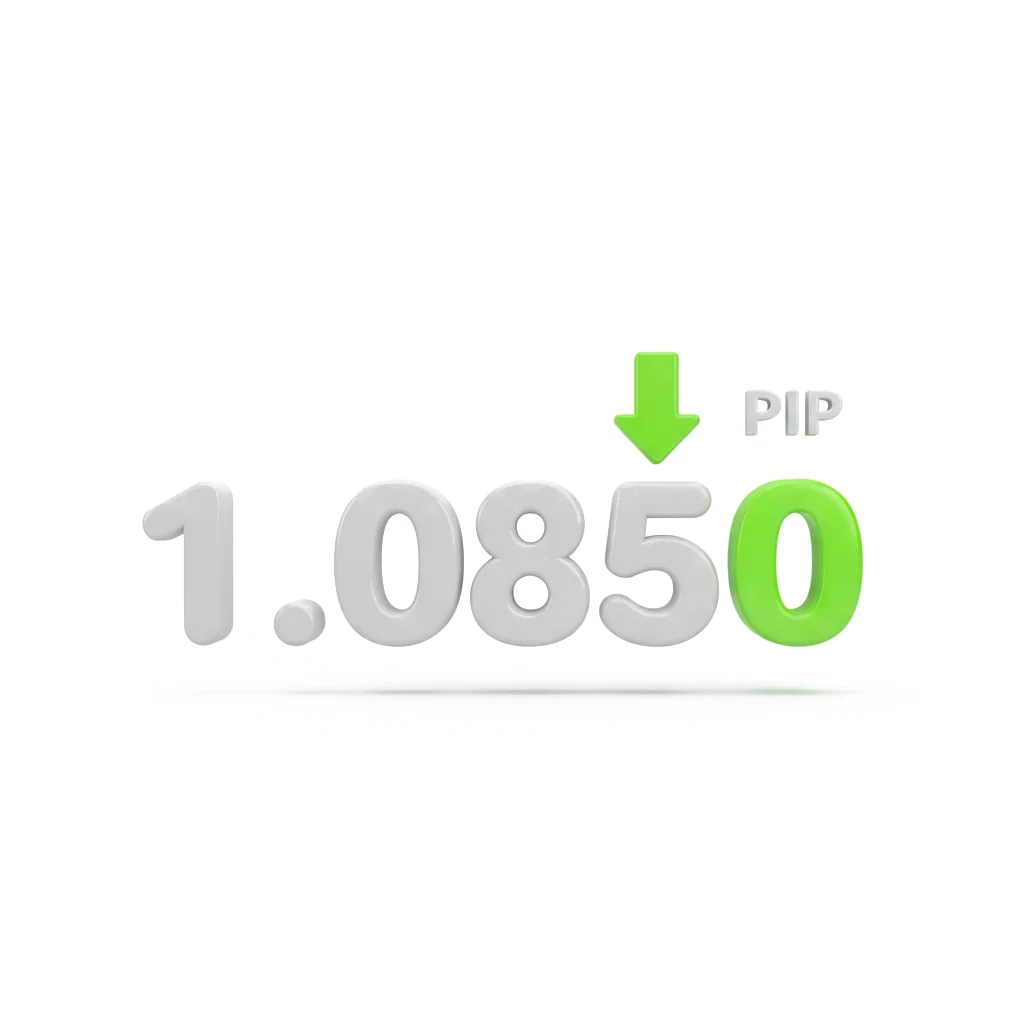
Most currency pairs are quoted to four decimal places, and the pip is that fourth decimal. If EUR/USD moves from 1.0850 to 1.0851, the price has moved exactly one pip.
Take the quote apart. In 1.0850, the decimals are 0, 8, 5 and 0. The first three set the general neighbourhood the price is trading in. The fourth one, the final 0, is the pip digit, and it is the digit that ticks up and down all day long.
Bigger moves work the same way, you just divide. From 1.0850 to 1.0900 is a change of 0.0050, and 0.0050 divided by 0.0001 gives 50 pips. From 1.0850 all the way to 1.1850 is 0.1000, or 1,000 pips, the sort of move that takes months rather than an afternoon.
Direction changes the sign, never the size. If you bought at 1.0850 and price is now sitting at 1.0820, that is a 30 pip move (0.0030 divided by 0.0001), it just happens to be 30 pips against you. Had you sold at 1.0850 instead, the exact same 30 pips would be in your favour. The measurement is neutral, your position decides who it helps.
The two second method
Subtract the two prices, then divide by 0.0001. That is the whole calculation. 1.0885 minus 1.0850 is 0.0035, divided by 0.0001 gives 35 pips.
The Japanese Yen Exception
Then there is the yen, which politely ignores the rule. Any pair with JPY on the right hand side (USD/JPY, EUR/JPY, GBP/JPY and friends) is quoted to two decimal places, and the pip is the second decimal, worth 0.01.
So USD/JPY moving from 152.30 to 152.31 is one pip. Moving from 152.30 to 152.80 is a change of 0.50, and 0.50 divided by 0.01 gives 50 pips. Same logic, different decimal.
The reason is scale. One dollar buys roughly 150 yen, so yen quotes sit two decimal places higher than everything else. If the pip were still 0.0001 there, every move would be reported in thousands of pips and the number would stop meaning anything useful.
One thing to park for later: instruments that are not currency pairs can follow their own decimal conventions on MT5, and gold is the usual example, where brokers do not all agree on what counts as a pip. Currency pairs themselves are consistent, so the four decimal rule plus the yen exception covers every pair you will meet in this lesson.

This is the exception, not one of many
You do not need to memorise a long list. If JPY is the second currency in the pair, the pip is 0.01. Everything else, it is 0.0001.

Ollie's tip
Count the decimals before you count the pips. Four for most pairs, and that fourth digit is where all the action lives.
Pipettes, and Why MT5 Says Points
Look at a modern broker feed and you will see one extra digit: EUR/USD quoted as 1.08504 rather than 1.0850, or USD/JPY as 152.305 rather than 152.30. That last digit is a pipette, also called a fractional pip or a tenth of a pip. Ten pipettes make one pip.
It exists so brokers can price more finely. A spread of 0.8 pips is only quotable if the extra decimal is there, otherwise everything gets rounded to whole pips and the pricing gets clumsy.
Here is the part that catches new MetaTrader 5 users. MT5 does not use the word pip in its order windows. It uses point, and a point is the last digit of the quote, which on a five decimal feed is the pipette. So 10 MT5 points equal 1 pip. Set a stop loss of "200 points" thinking it means 200 pips and you have actually given the trade 20 pips of room, which is a very different trade.
You never have to guess which setup your broker uses. Open the pair in MT5 and count the decimals in the price. Five decimals (or three on a yen pair) means pipettes are switched on and points are tenths of a pip. Four decimals (or two on a yen pair) means the last digit is the pip itself.

What One Pip Is Actually Worth in Money
A pip measures movement. It says nothing about money until you add position size. The formula is refreshingly boring: pip value = pip size x position size in units.
Position sizes come in lots. A standard lot is 100,000 units of the base currency, a mini lot is 10,000 units, and a micro lot is 1,000 units. In the MT5 order window these appear in the Volume box as 1.00, 0.10 and 0.01.
Run the formula on EUR/USD with a standard lot: 0.0001 x 100,000 = $10 per pip. Scale down and it scales cleanly, because everything here is just multiplication.
Yen pairs give you an answer in yen, so there is one extra step. On USD/JPY, a standard lot gives 0.01 x 100,000 = 1,000 yen per pip. Convert at a rate of 150.00 and 1,000 divided by 150 is about $6.67. That figure drifts as the exchange rate moves, which is why yen pip values are never quite as tidy.
| Lot size (MT5 volume) | Units | Pip value on EUR/USD | Pip value on USD/JPY at 150.00 |
|---|---|---|---|
| Standard (1.00) | 100,000 | $10.00 | 1,000 yen (about $6.67) |
| Mini (0.10) | 10,000 | $1.00 | 100 yen (about $0.67) |
| Micro (0.01) | 1,000 | $0.10 | 10 yen (about $0.07) |

Ollie's tip
MT5 talks in points, not pips, so multiply by ten. I once set a stop ten times tighter than I meant to.
One Trade, Counted Step by Step
Say you buy EUR/USD at 1.0850 with a volume of 0.10 lots, with a target at 1.0885 and a stop loss at 1.0830. Here is the full arithmetic, nothing hidden.
Step 1, position size: 0.10 x 100,000 = 10,000 units. Step 2, pip value: 0.0001 x 10,000 = $1.00 per pip. Step 3, the winning distance: 1.0885 minus 1.0850 = 0.0035, which divided by 0.0001 is 35 pips. Step 4, the money: 35 x $1.00 = $35 profit.
Now the other direction. Your stop sits closer to entry than your target does, so it is the level price reaches more often. Price drops to your stop at 1.0830. That is 1.0850 minus 1.0830 = 0.0020, or 20 pips, and 20 x $1.00 = $20 loss. You risked $20 to make $35 on that setup.
One more cost that beginners forget: the spread. If EUR/USD costs you 1.2 pips to enter, that is 1.2 x $1.00 = $1.20 gone the moment the trade opens, which is why every position starts slightly red. Small on one trade, less small across two hundred of them.
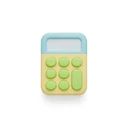
Same trade, three position sizes
That identical 35 pip winner and 20 pip loser becomes $350 and $200 on 1.00 lots, $35 and $20 on 0.10 lots, or $3.50 and $2.00 on 0.01 lots. The pips never changed. Only the size did.
Pips Are a Measuring Tape, Not a Scoreboard
Because pips ignore position size, they are a poor way to judge how you are doing. A 100 pip day can mean $10 or $1,000 or a genuinely painful number, depending entirely on the volume you clicked. Two traders can post the same pip count and have had completely different weeks.
This matters for risk. Position size, not pip count, decides how much of your account is on the line. Regulated brokers in Europe must publish the share of their retail CFD accounts that lose money, and the figure usually lands somewhere between 65% and 85%, with oversized position sizing a common contributor.
So build one habit early: before you confirm any order, translate the distance to your stop into money. "20 pips" is abstract. "$20, which is 2% of my account" is a decision you can actually make.
None of which makes pips useless. They are exactly the right tool for comparing setups, measuring how far a pair typically travels, and keeping stop distances consistent from one pair to the next. Read them before the trade, and let the money column tell you how it actually went.
Ollie's tip
Run those four steps on paper before your first live trade. Cheapest arithmetic lesson you will ever buy.
Professor Ollie's Lesson

- One pip equals 0.0001 on most currency pairs and 0.01 on any pair quoted in Japanese yen.
- A pipette is one tenth of a pip: the 5th decimal on EUR/USD, the 3rd decimal on USD/JPY.
- Pip value = pip size x units, so 0.0001 x 100,000 gives $10 per pip on a standard EUR/USD lot.
- The same pip is worth $10 on 1.00 lots, $1.00 on 0.10 lots and $0.10 on 0.01 lots.
- In MetaTrader 5 a point is a pipette, so a stop loss of 200 points is only 20 pips of room.
Check yourself
Five quick questions on this lesson. Nothing is saved and nobody is watching.
USD/JPY climbs from 151.20 to 151.55. How far has it travelled?
Common questions
QHow much is 1 pip worth in dollars?
It depends entirely on your position size. On a USD quoted pair like EUR/USD, one pip is $10 on a standard lot (100,000 units), $1.00 on a mini lot (10,000 units) and $0.10 on a micro lot (1,000 units). On yen pairs the value comes out in yen first: a standard lot gives 1,000 yen per pip, which is roughly $6.67 when USD/JPY trades at 150.00.
QWhy do JPY pairs have a different pip size?
Because of price scale. One dollar buys around 150 yen, so yen pairs are quoted to two decimals (152.30) instead of four (1.0850). The pip is set at the second decimal, 0.01, so that a typical daily move still reads as a sensible two or three digit pip number rather than thousands.
QIs a pip the same as a point in MetaTrader 5?
No, and this trips up a lot of new traders. MT5 defines a point as the last digit of the quote. On a five decimal pair like EUR/USD that last digit is the pipette, so 10 points equal 1 pip. A 500 point stop loss in MT5 is a 50 pip stop, not 500.
QHow many pips does EUR/USD usually move in a day?
In calm conditions the daily range on EUR/USD commonly sits somewhere around 50 to 100 pips, though it varies a great deal. Quiet holiday sessions can produce half that, while central bank decisions or surprise inflation data can easily double it. Treat any average daily range figure as a rough guide, never a guarantee.
What Is Forex Trading and How Does It Work?
Next lesson →What Is a Spread in Trading?
Risk warning. Trading forex and CFDs carries a high risk of losing money rapidly due to leverage. This lesson is educational content, not financial advice. Professor Ollie is our teaching mascot. Lessons are written and reviewed by The Trading Classroom editorial team.